
We often receive questions regarding our methodology, conclusions and general practice. We have answered some of our frequently-asked-questions to help you understand our process and what to expect from us.
contents
- What is forensic speaker comparison?
- How are conclusions presented in forensic speaker comparison casework?
- Is forensic speaker comparison the same strength evidence as DNA?
- What are the limitations of forensic speaker analysis?
- Who do the Forensic Voice Centre work for?
- Do you accept work from private individuals?
- How much does voice comparison cost?
- How long does analysis take?
- Do you analyse speech in other languages?
- Are you able to detect editing in recordings?
1. What is forensic speaker comparison?
Speaker comparison is the scientific process of comparing the voice and speech patterns of a known suspect with the voice and speech patterns of an unknown voice on a recording. We use auditory analysis (detailed listening) and acoustic analysis (computer-based measurements) to assess the likelihood that the voices originate from the same person, or different people.
2. How are conclusions presented in forensic speaker comparison casework?
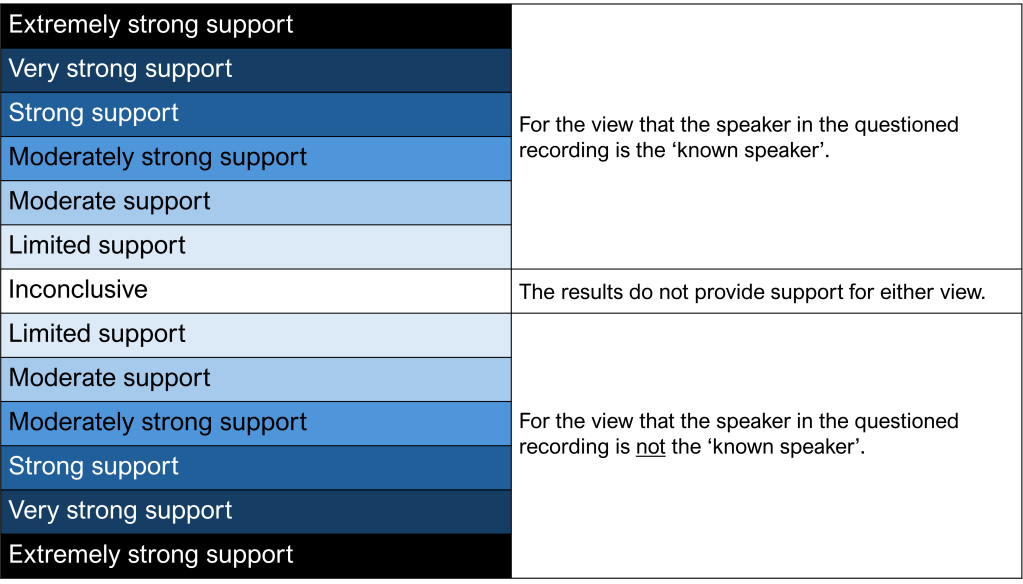
We provide an expert report/statement for each case. Our conclusions are chosen from a 13-point scale; the conclusion is based on the evaluative opinion of the reporting analyst which is always checked by a secondary expert. There are six levels to indicate a “positive” conclusion (i.e., the speakers are the same person) and six levels to indicate a “negative” conclusion (i.e., the speakers are different people). In the middle of the scale is the level of “inconclusive” whereby the results of the analysis do not support either a positive or negative result. The further the conclusion from the mid-point, the stronger the conclusion. We do not use terms such as “match” or “non-match” and we do not report numerical values (e.g., “99% match”)
3. Is forensic speaker comparison the same strength evidence as DNA?
The results of speaker comparison analysis can be tendered in evidence and are robust to cross-examination. However, it does not provide the same strength of evidence as DNA. We follow the recommendations put forward by the International Association for Forensic Phonetics and Acoustics (IAFPA) that this evidence is used in conjunction with other evidence.
4. What are the limitations of forensic speaker Comparison analysis?
There are many limitations that affect the extent to which we can compare or transcribe recordings. These limitations can affect the strength of the conclusions, or render the analysis unsuitable. Limitations include:
brevity
Recordings that contain a small amount of free-flowing speech.
quality
Poor technical quality or heavy background noise.
distance
Speech spoken at a distance from the recording device that was not recorded clearly at the time of recording.
level
Extremely raised speech or whispered speech.
style
Speech where the speaker is reading aloud or adjusting how they talk to address children or animals.
disguise
Speech where the speaker is disguising their voice either to sound unlike themselves or to sound like someone else.
Mismatch
Where the recordings to be compared are very different in terms of any of the factors listed above.
5. who do the forensic voice centre work for?
We are independent experts who work for both the prosecution and the defence in many types of legal matters, including criminal, civil and family cases.
6. Do you accept work from private individuals?
We accept work for private or personal matters but we request that the enquiry is made through a solicitor or legal representative. If you qualify for Legal Aid, please arrange for your solicitor to contact one of our team.
7. How much does voice comparison cost?
We require the team of experts to screen the recordings before we provide you with a financial estimate to ensure the most accurate estimate possible. This applies to all our services, including voice comparison.
8. How long does analysis take?
It is hard to estimate an exact turnaround time before we have screened the recordings for suitability. At present, we are able to accept new cases and have a turnaround time of approximately 6-8 weeks (standard cases) – 8-10 weeks (more complex cases) from the point of financial authorisation and receipt of all material. This could be shorter or longer depending on the circumstances of the case; we can sometimes take on urgent work on request.
9. can you compare recordings in another language?
We do not provide comparison or transcription services for non-English speech recordings. However, we may be able to enhance recordings that contain non-English speech to be used for transcription by external language experts. Please contact us to discuss the requirements of your case.
10. Are you able to detect editing in recordings?
Audio authentication is the process of determining if a recording is authentic or if it has been edited or tampered with. This is not a service we provide currently, but we are able to recommend other experts in the field that may be able to assist with the enquiry.

 The Forensic Voice Centre